01
The business problem
Scheduling tools are useful because they remove back-and-forth. But they can also become quiet overhead: another paid account, another branded handoff, another external surface in the funnel, and another system that has to match how the business actually sells.
For Tessera, the job was not to invent a novel calendar product. The job was narrower and more commercially useful: let a prospect choose a valid time, capture the right context, create the event, and keep the experience inside Tessera's own website.
System effect:The optimisation was not about replacing software for the sake of it. It was about removing a paid dependency where the workflow was simple enough to own.
02
The intervention
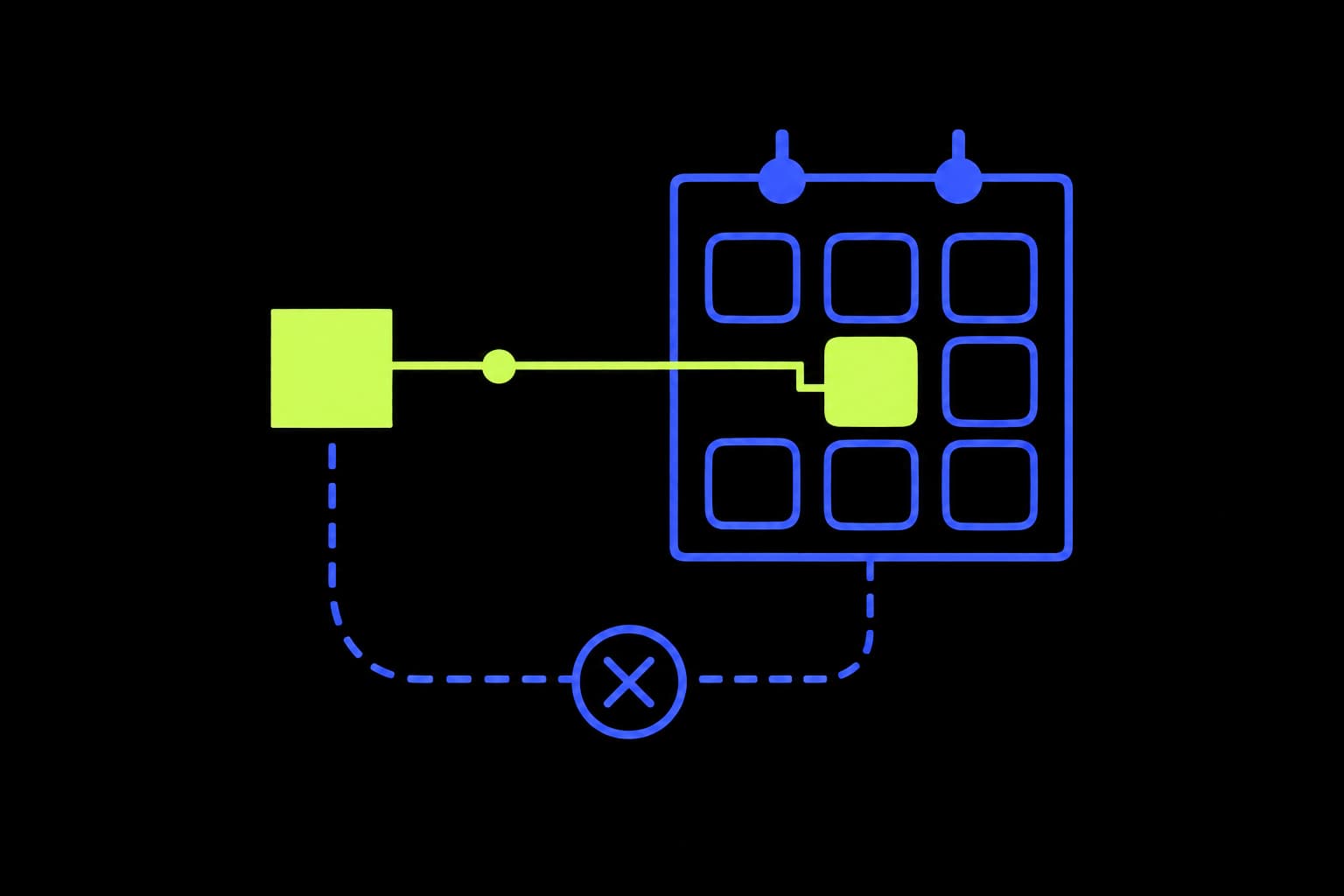
Tessera built a native discovery booking page with a Google Calendar backend. The page checks live availability, validates the selected slot server-side, creates the calendar event, and handles the failure cases that matter: expired slots, duplicate bookings, invalid times, and excessive submissions.
The system deliberately stayed small. It did not recreate every scheduling-product feature. It replaced the business-critical path: qualified prospects being able to book a call without email ping-pong or operational drag.
Before
A third-party scheduling link handled availability and booking, adding external branding, external policy decisions, and a paid dependency to a simple conversion step.
After
Tessera owns the booking experience on its own site, backed by Google Calendar and guarded by server-side validation, rate limiting, and optional bot protection.
03
How the system works
It uses the existing calendar as the source of truth
Availability is calculated against Google Calendar rather than a new scheduling database. That keeps the operating model simple: the calendar remains the canonical place for busy time, events, and real-world availability.
It validates booking decisions on the server
The booking API checks that the requested slot is valid before it creates the event. If a slot becomes unavailable while a visitor is booking, the system asks them to choose another time instead of creating a conflict.
It keeps the public experience focused
The interface asks for the minimum useful context, shows a small set of available slots, and confirms the booking without sending the prospect away to a separate product experience.
It leaves room for different call types
The initial discovery-call system was later extended toward shorter intro calls for vertical landing pages. That is the benefit of owning the workflow: call length, context fields, and routing logic can evolve with the funnel instead of being forced through a generic SaaS configuration model.
04
Why this matters to business decision makers
The point is not that every business should rebuild every tool. Most should not. The point is that AI-assisted implementation changes the build-versus-buy threshold for narrow workflows. When a recurring tool mostly performs one predictable job, a small owned system may now be cheaper, cleaner, and easier to adapt than another subscription.
That creates a practical optimisation pattern: audit the stack, identify tools that are only doing one or two simple jobs, replace the lowest-risk workflow first, and keep the human approval gate where the business risk actually lives.
Commercial takeaway
AI-enabled delivery can turn expense optimisation from a slow procurement exercise into a controlled implementation sprint: remove one dependency, preserve the customer outcome, and keep the system small enough to maintain.
Want to find your lowest-risk automation opportunity?
Tessera identifies the workflows where AI-assisted implementation can reduce operating cost, remove fragile handoffs, or improve conversion without forcing a risky platform rebuild.
Book a 15-minute intro call